Over/under markets look simple, but the line you choose changes the way your bet is settled. This beginner guide explains the main goal totals, including 2.5, 3.0 and 2.25, with practical score examples.
Over under betting is one of the most common ways to read a football match market because it focuses on total goals, not which team wins. Instead of backing the home side, away side or draw, you decide whether the combined number of goals will finish above or below a line set by the market.
For beginners, that sounds straightforward: more goals or fewer goals. The important detail is the line. A total of 2.5 goals is settled differently from 3.0 goals, and a quarter line such as 2.25 goals can create a half-win or half-loss. This guide explains those rules clearly, using hypothetical score examples only.
What over under betting means in football
In football totals, the market sets a goal line before the match or during live play. You then choose over, meaning you expect the match to produce more goals than that line, or under, meaning you expect fewer goals than that line. This is often called over under goals betting, totals betting, or simply the goals market.
The key point is that both teams’ goals are added together. A 2-1 score has three total goals. A 0-0 score has none. A 3-2 score has five. The identity of the scorer, the minute of the goal and the winning team do not matter for standard full-time totals unless the market rules say otherwise.
For example, if the line is 2.5 goals, the market is asking whether the match will finish with at least three goals or with two goals or fewer. The half-goal is not a real score; it exists to remove the possibility of a tie between the final total and the betting line.
This is why many football predictions discuss likely match tempo, finishing quality, defensive structure, game state and team motivation before touching a totals line. A strong opinion on who might win does not automatically equal a strong opinion on the number of goals.
The main goal lines: 2.5, 3.0 and 2.25
Most beginners first meet totals through 2.5 goals. Asian totals add more line types, including whole numbers and quarter numbers. These lines are not complicated once you understand pushes and split stakes.
Over/under 2.5 goals
The 2.5 line is the cleanest version because there can be no push. The final total will always be either above or below 2.5.
If you back over 2.5 goals, you need three or more total goals. Scores such as 2-1, 3-0, 1-2 and 2-2 all settle as wins for the over. Scores such as 0-0, 1-0, 1-1 and 2-0 settle as losses for the over.
If you back under 2.5 goals, it is the opposite. You need zero, one or two total goals. A 1-1 draw is under 2.5 because it contains two goals. A 2-1 score is over 2.5 because it contains three.
Over/under 3.0 goals
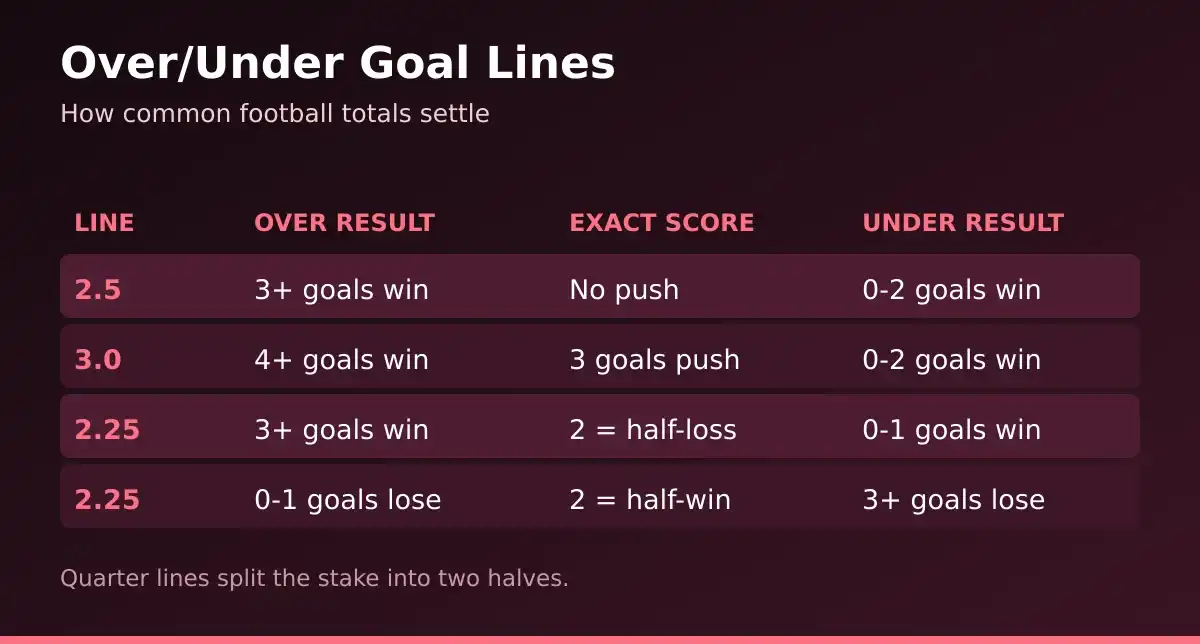
The 3.0 line is a whole-goal Asian total. Because football matches can finish with exactly three total goals, this line includes the possibility of a push. A push means the selection is neither a win nor a loss, and the stake on that selection is returned under standard settlement rules.
If you back over 3.0 goals, you need four or more total goals to win. A 2-2 score wins because it has four goals. A 2-1 score has exactly three goals, so it pushes. A 1-1 score loses because it has two goals.
If you back under 3.0 goals, you need two or fewer total goals to win. A 1-0 score wins. A 2-1 score pushes. A 3-1 score loses because it has four goals.
Over/under 2.25 goals
The 2.25 line is a quarter-goal Asian total. It is best understood as two half-stakes: one half on 2.0 goals and one half on 2.5 goals. This is the part many beginners miss when looking for asian totals explained.
If you back over 2.25 goals, half your stake is on over 2.0 and half is on over 2.5. With three or more goals, both halves win. With exactly two goals, the over 2.0 half pushes and the over 2.5 half loses, so the overall result is a half-loss. With zero or one goal, both halves lose.
If you back under 2.25 goals, half your stake is on under 2.0 and half is on under 2.5. With zero or one goal, both halves win. With exactly two goals, the under 2.0 half pushes and the under 2.5 half wins, so the overall result is a half-win. With three or more goals, both halves lose.
| Line | Selection | Example score | Settlement |
|---|---|---|---|
| 2.5 | Over | 2-1 | Win |
| 2.5 | Under | 1-1 | Win |
| 3.0 | Over | 2-1 | Push |
| 3.0 | Under | 3-1 | Loss |
| 2.25 | Over | 1-1 | Half-loss |
| 2.25 | Under | 1-1 | Half-win |
How pushes and half settlements work
A push is easiest to understand on a whole number. If the line is 3.0 and the match finishes with exactly three goals, the result lands on the line. Under standard Asian total settlement, that part of the bet is void and the stake for that part is returned.
Quarter lines create half settlements because they split the stake across two adjacent lines. A 2.25 total is half 2.0 and half 2.5. A 2.75 total, by the same logic, is half 2.5 and half 3.0. You do not need to calculate a new market from scratch; you only need to split the line into its two parts.
Here is a simple hypothetical example. Suppose a bettor places the same unit on over 2.25 goals and the match finishes 1-1. The final total is two goals. The over 2.0 half pushes because the match landed on two. The over 2.5 half loses because two goals are not enough. The combined result is a half-loss.
Now reverse it. If the same match is settled for under 2.25 goals, the under 2.0 half pushes and the under 2.5 half wins. The combined result is a half-win. This is why two people can look at the same 1-1 score on a 2.25 line and have different outcomes depending on whether they selected over or under.
Settlement rules for standard totals are broadly consistent, but details can vary for abandoned matches, extra time, live markets and special bet types. Always read the rules attached to the specific market, especially if the market is not listed as regular time only.
Reading totals like a beginner analyst
A totals market is not only a number. It is a summary of expectations. To form your own view, start with the likely match pattern before looking at the exact line.
Ask whether both teams are likely to create chances, whether one side may control possession without taking risks, and whether the match context could change behaviour. A cup tie, a second leg or a league match with different incentives can all affect how open a game becomes. These ideas are common in soccer betting tips, but they should be used as context rather than as certainty.
The next step is to compare your view with the line. If you expect a cagey match with limited clear chances, under 2.5 may make sense in theory. If you expect both teams to attack and leave space, the over might be more attractive in theory. The phrase “in theory” matters because football is low-scoring and unpredictable.
Then think about the protection offered by the line. A 3.0 total gives over backers a push if the match finishes with exactly three goals, while over 2.5 needs three goals to win but has no push. A 2.25 line sits between 2.0 and 2.5, so it softens the settlement around exactly two goals.
This is also where totals differ from handicap markets. Soccer Handicap Tips and Football Handicap Tips focus on goal margins between teams, while totals focus on the combined number of goals. Asian Handicap Tips and Handicap Betting Tips can be useful comparisons, but do not mix up margin logic with total-goals logic.
Readers who compare different previews should look for reasoning, not just a pick. A good preview explains why a line is being discussed. It may mention tactical style, likely game state or risk, without pretending that one angle guarantees the final score. You can find broader football tips and match context on Wintips.com, while the phrase Soccer Tips is often used more generally for prediction content across the football betting space.
Common mistakes with over/under goals
The first mistake is treating all overs as aggressive and all unders as negative. An under selection is not a prediction that “nothing will happen”. It is simply a view that the final total will stay below the chosen line. A match can be lively and still finish 1-1.
The second mistake is ignoring the exact number. Over 2.5 and over 3.0 are not the same bet. A 2-1 score wins over 2.5 but pushes over 3.0. That difference matters when you review your results and when you compare prices, even though this guide does not discuss specific odds.
The third mistake is misunderstanding quarter lines. On 2.25, exactly two goals is not a full push. It is a half-loss for the over and a half-win for the under. On other quarter lines, the same split-stake principle applies.
The fourth mistake is using team reputation alone. A well-known attacking team can still play a controlled match. A defensive side can be pulled into an open game by an early goal. Totals analysis works better when it considers match-up, tempo and context together.
The fifth mistake is chasing after an early loss. Over/under markets are simple to follow, which can make them tempting during live play. But quick decisions after a goal or missed chance often come from emotion rather than analysis.
Conclusion: use the line before the opinion
The best starting point for over under betting is not “Will this be exciting?” but “What does this exact line need?” Over 2.5 needs three goals. Over 3.0 needs four goals to win, with exactly three as a push. Over 2.25 is split between 2.0 and 2.5, which creates half settlement around exactly two goals.
Once you understand the settlement, you can read totals markets with more confidence. You still need judgement, patience and a clear view of risk, but at least the result of each scoreline will make sense before the match starts.
Frequently asked questions
What does over 2.5 goals mean?
Over 2.5 goals means the match must finish with at least three total goals. Scores such as 2-1, 3-0 and 2-2 win for over 2.5, while 0-0, 1-0, 1-1 and 2-0 lose.
What happens if over 3.0 goals finishes exactly 3 goals?
It is a push under standard Asian total rules. For example, a 2-1 score has exactly three goals, so the over 3.0 selection is void and the stake for that selection is returned.
Is under 2.25 a full win if the score is 1-1?
No. A 1-1 score has exactly two goals. Under 2.25 is half under 2.0 and half under 2.5, so the under 2.0 half pushes and the under 2.5 half wins. The result is a half-win.
Gambling is for adults aged 18+ only. Set limits, treat betting content as information rather than certainty, and never stake money you cannot afford to lose.